
The lowest bid isn’t necessarily the best choice. Knowing how to choose a home remodeling contractor means weighing more than the proposal: check licensing and insurance, relevant project experience, a clear written scope, references, communication, and familiarity with your local area. These checks help you assess how a contractor will plan and manage the work, not just describe the finished room.
It’s reasonable to want a beautiful result and confidence that the process will be orderly, with decisions about materials, permits, scheduling, and project changes handled clearly. Comparing contractors can feel difficult when each proposal emphasizes different details. A careful, consistent review makes it easier to see what’s included and how each team approaches the work.
This guide explains what to check before hiring, how to compare proposals on equal terms, and what to learn from references and online reviews. It also covers communication and local experience for homeowners planning renovations in Fairfax, Arlington, Alexandria, and nearby Northern Virginia communities. A practical framework helps you make a decision based on fit, accountability, and how the project will support your daily life.
Key Takeaways
- Confirm that a contractor’s license and insurance are current and appropriate for the work.
- Compare written proposals using the same project scope, materials, and quality expectations.
- Use references and online reviews to learn how past projects were handled and whether clients would hire the contractor again.
- Agree on how project updates, approvals, schedule changes, and unexpected issues will be communicated.
- Choose local experience that reflects familiarity with your home’s needs and the permitting process in your area.
What should you check before hiring a remodeling contractor?
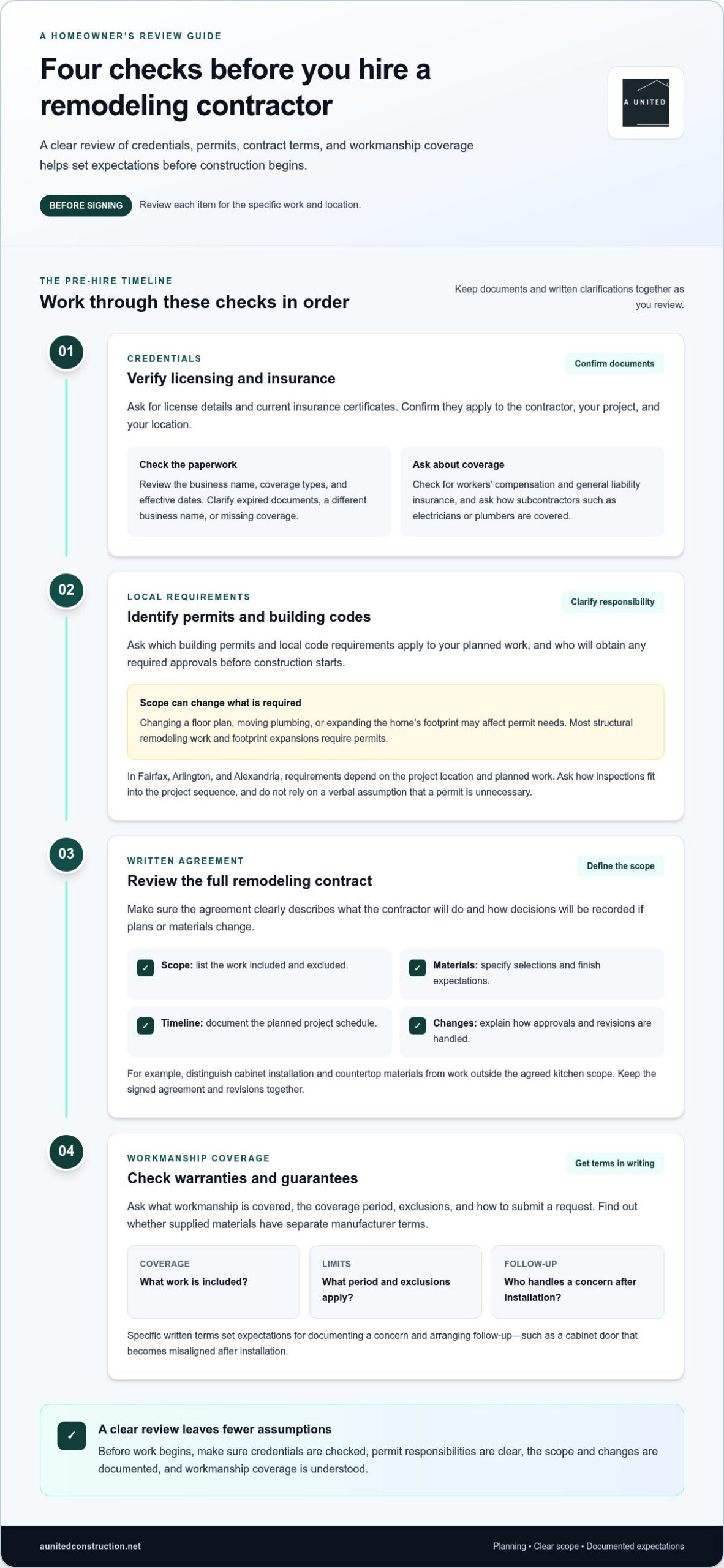
Before signing, review four areas: credentials, local requirements, contract terms, and workmanship coverage. Each check clarifies responsibility, project scope, and the standards guiding the work.
Verify licenses and insurance
Ask for the contractor’s license details and current insurance certificates, then confirm they apply to your project and location. Licensing rules differ across U.S. states, so verify the requirements for your jurisdiction rather than assuming one credential covers every renovation. The National Association of Home Builders (NAHB) advises homeowners to confirm workers’ compensation and general liability insurance. These policies address different risks, including worker injuries and liability for construction-related accidents on your property.
Review the business name, coverage types, and effective dates on each document. Ask how subcontractors are covered, especially when work involves electricians or plumbers. A certificate that has expired, names a different business, or omits relevant coverage needs clarification before work begins. Treat clear communication about insurance as one part of assessing the contractor’s professionalism, not a substitute for reviewing the documents.
Identify applicable permits and building codes
Ask which building permits and local code requirements apply to your specific scope, such as changing a floor plan, moving plumbing, or expanding the home’s footprint. Building codes and permit requirements vary by jurisdiction and can change over time. Most structural remodeling work and footprint expansions require permits, so establish who will obtain them before construction starts.
In Fairfax, Arlington, and Alexandria, requirements depend on the project location and planned work. Ask the contractor to identify required approvals and explain how inspections fit into the project sequence. Permits allow local inspectors to review plans and check whether work meets code requirements. Don’t rely on a verbal assumption that a permit is unnecessary, particularly when structural elements or additions are involved.
Review the remodeling contract
Read the full written agreement before authorizing work. NAHB advises homeowners to get a complete, clearly written contract. It should define the scope, materials, payment schedule, project timeline, and procedures for changes. For a kitchen renovation, for example, distinguish cabinet installation and countertop materials from work outside the agreed scope.
Confirm how approvals are recorded when plans or materials change, and keep the signed agreement and revisions together. The contract should clarify responsibilities, including who coordinates building permits and communicates schedule updates. Avoid relying on verbal estimates or informal assurances. Written terms give you and the contractor a shared reference if questions arise during construction.
Check warranties and workmanship guarantees
Ask for any warranty terms in writing before signing, including what workmanship is covered, the coverage period, exclusions, and how to submit a request. The agreement should explain whether supplied materials have separate manufacturer terms, so you can distinguish product coverage from work performed during the remodel.
Review the process for documenting a concern and arranging follow-up. For example, clarify whom to contact if a cabinet door becomes misaligned after installation, and what information the contractor needs to assess it. Understanding how long-term property upkeep will be structured—similar to how comprehensive property and infrastructure specialists such as House of Maverick approach maintenance services—ensures your home remains well-supported long after construction is complete. Don’t rely on a broad verbal promise: specific written terms set clear expectations and help you evaluate accountability for craftsmanship.
Comparing contractors before making a final decision
Compare proposals on equal terms, then weigh relevant experience, local familiarity, and how each team organizes its work. A structured review helps you assess which contractor’s planning approach best fits your vision and your home’s needs. To decide how to choose a home remodeling contractor, look beyond presentation and compare how each proposal addresses the same project requirements.
Compare estimates using the same scope
Give each contractor the same project description, plans, and material selections before reviewing estimates. For a bathroom renovation, compare whether each proposal includes the same floor plan changes, fixtures, installation tasks, and finish level. Note what is included, excluded, or left for later selection. These details show whether the proposals describe the same finished project.
Review the order of work, specified materials, and how each team explains its approach. Ask for written clarification when descriptions differ or rely on broad terms. A well-defined scope shows what the contractor intends to complete and where decisions are still needed. That makes comparisons more useful than judging proposals by presentation alone.
Review company longevity and case studies
Consider how long each company has operated, then examine completed projects similar to your renovation. The National Association of Home Builders advises homeowners to consider a remodeler’s time in business, noting that establishing a financially sound business usually takes three to five years. Longevity is one factor to weigh alongside relevant work and evidence of careful craftsmanship.
Compare local remodeling companies
Assess each company’s experience with homes and projects in Fairfax, Arlington, or Alexandria. Local references and completed work can help you judge whether a contractor understands nearby homes and the practical needs of your project. Compare examples that resemble your home and renovation goals, not just polished photographs.
Meet with the contractors you’re considering and notice how carefully they listen. For example, a household seeking a quieter kitchen workflow may value a plan that considers appliance placement and circulation. Clear explanations of design choices and construction trade-offs help you assess whether a proposal reflects your needs or takes a generic approach.
Review deposits and payment schedules
Review the proposed payment schedule alongside project milestones. Check when each payment is due, which stage of work it corresponds to, and how the agreement handles schedule changes. A clear sequence links payments to defined progress and helps you understand your responsibilities at each stage.
Before signing, make sure the schedule is written into the agreement and aligns with the stated scope and change procedures. Ask how schedule adjustments are documented if the project sequence changes. As you consider how to choose a home remodeling contractor, weigh whether the written terms give you a clear way to track progress and responsibilities. You can review home renovation planning considerations alongside the proposals.
Checking client references and online reviews
Past clients can reveal how a contractor handled construction details, communication, and follow-through. Compare references, review patterns, complaint records, and relevant professional credentials.
- Ask for references from projects completed at different times, not only the contractor’s latest work. Include a project similar to yours, such as a bathroom renovation with custom finishes. Ask each homeowner whether the work matched the agreed scope, how questions were handled, and whether they would hire the contractor again. NAHB recommends asking previous customers whether they would choose the builder or remodeler again.
Whenever possible, speak with a reference by phone or visit a completed project. Ask what happened when plans changed, materials were delayed, or an issue needed attention. A specific example offers more insight into the contractor’s expertise than a general statement of satisfaction.
- Read online reviews across more than one source, and look for recurring details rather than relying on a single rating. Comments about timely updates, clean work areas, or unresolved concerns can help you understand how the contractor manages everyday interactions. Compare those patterns with the references you contacted.
Notice how a business responds to criticism. A clear, professional reply that addresses a concern provides context, though it doesn’t establish what happened. For example, repeated reviews mentioning missed updates may be worth discussing with references before you decide.
Check complaints and violations
Search the Better Business Bureau (BBB) for the contractor’s rating and complaint history; NAHB advises homeowners to review both. You can also check your Consumer Affairs Office for recorded complaints. Read each entry carefully, noting the issue, the response, and the recorded outcome instead of treating every complaint as proof of a pattern.
Compare any concerns with references and project examples. If a complaint mentions building codes or unfinished construction, ask references whether they experienced similar issues. Look for consistent, specific information across sources before drawing conclusions.
- Review professional certifications and awards as supporting evidence, not as substitutes for project experience or references. NARI offers eight certifications for remodeling professionals. Check what a credential represents and whether it relates to the work planned for your home, such as kitchen design or project management.
Ask whether contractor bonding applies to the project and location, since requirements vary. If the contractor is bonded, request the bond details and understand what it covers. A certification, award, or bond is not a guarantee of successful workmanship; evaluate each alongside documented projects and client feedback.
Look for scam warning signs
Be cautious if a contractor refuses written estimates, avoids explaining the project scope, or won’t provide references. A much lower estimate than the others also deserves scrutiny, particularly if material or labor details are unclear.
Before proceeding, compare the proposal with the agreed work and seek clear answers about any gaps. For peace of mind, base your decision on consistent documentation, credible references, and direct, professional communication.
Maintaining communication during the renovation
Agree on how updates, approvals, and schedule changes will be handled before work starts. A written communication plan keeps expectations clear as construction moves from one stage to another.
Set project communication expectations
Ask who will provide updates, how you’ll receive them, and how decisions should be approved. Record the agreed method, such as email for selections and a scheduled call for larger project discussions. A written project schedule gives you a shared view of major stages, even when it isn’t part of the remodeling contract.
Discuss the expected timeline and how the contractor will communicate delays or unexpected issues. Custom remodeling can involve coordinating electricians, plumbers, and other subcontractors, so ask how changes to one trade’s work affect the next stage. A clear process helps you understand what may shift and when your decision is needed.
Evaluate contractor communication
Notice how the contractor handles questions during planning. Do explanations address your specific renovation, or rely on general assurances? For example, if you ask how a cabinet selection affects installation timing, a useful response explains the decision needed and its place in the project sequence.
During construction, expect regular updates and a clear way to raise concerns. Agree on who handles approvals, how decisions are documented, and how urgent project questions reach the responsible person. Clear communication won’t prevent every delay, but it helps you follow the work and understand the next step.
- Use references and online reviews to assess communication. Look for specific comments about responsiveness, explanations, and how concerns were addressed, rather than relying only on general praise. If a past customer describes a schedule change, ask how the contractor explained its effect and kept expectations aligned. Compare those details with your own planning conversations.
Credentials and strong reviews matter, but they don’t show exactly how updates will work on your project. Use your conversations to set practical expectations: who shares progress, how material decisions are confirmed, and where approved changes are recorded. These points make communication easier to assess throughout the renovation.
- Keep a shared record of decisions. Save written approvals, updated schedules, and messages about changes in one place. For example, if a selected finish changes after ordering, record the new choice and any resulting adjustment to the work sequence. A consistent record helps you and the contractor refer to the same expectations.
Review the schedule together when a new issue affects dependent work. Ask which tasks can continue and which need a decision or revised plan. This keeps the conversation focused on the timeline and the next practical step, instead of leaving you unsure what happens next.
Choosing a local contractor
Local experience matters because a project in Fairfax, Arlington, or Alexandria must suit both the home and its jurisdiction. Compare how contractors plan for local conditions, coordinate requirements, and translate your priorities into practical construction decisions.
- Seek referrals from people familiar with remodeling in your community. Ask relatives, neighbors, colleagues, real estate agents, lenders, or local material suppliers about contractors they’ve worked with. A referral can point you to a nearby project to review, but it should start your assessment, not replace it.
Look for examples in Fairfax City, Burke, Springfield, Reston, or another nearby neighborhood with homes and project needs similar to yours. A kitchen update in an older home may raise different planning questions than a renovation in a newer property. Ask what the contractor learned from the project and how that experience could inform your plans.
- Discuss your property and goals with multiple local contractors before deciding. Describe how you use the space, what you want to change, and what must remain functional during construction. For a kitchen, explain whether you need better circulation, more storage, or a layout suited to family meals. Compare how each contractor turns those priorities into a practical plan.
Use these conversations to assess whether the contractor listens and explains trade-offs clearly. If your vision includes changing walls or relocating plumbing, ask how those choices affect the project plan. A useful discussion connects design decisions with construction needs, rather than treating appearance and function as separate concerns.
- Ask how the contractor anticipates conditions specific to your home and project. Remodeling may involve load-bearing adjustments or plumbing relocations, so discuss how those possibilities are identified and included in planning. For an addition, ask how the proposed footprint and connection to the existing home shape the work.
Clarify who handles required building permits and how the work will be reviewed for local code compliance. Requirements vary by jurisdiction, and permits allow local inspectors to review plans and check that work meets code. In Fairfax, Arlington, and Alexandria, the property address and scope help determine the relevant local process.
- Check local references and, where useful, your local NARI chapter for remodelers’ community experience. Ask past customers about the finished work, project coordination, and whether they would hire the contractor again. A nearby reference can also describe how the team handled site access, household routines, or changes to the plan during construction.
Use these conversations to judge whether the contractor’s approach suits your priorities and budget, without choosing on proximity alone. For a Northern Virginia kitchen project, discuss your layout and goals with a team focused on kitchen remodeling planning. The right local fit combines relevant experience, quality work, and a clear path from your vision to a functional result.
Permit and code requirements vary by jurisdiction. Your project’s address and scope help determine the applicable local process in Fairfax, Arlington, or Alexandria. Clarify with the contractor who will handle required permits and how local inspectors will review the plans and check the work for code compliance.
A United Construction: Kitchen Remodeling
A United Construction is a family-owned, Virginia Class A licensed and fully insured contractor. Its Kitchen Remodeling service brings design, construction, and project management together to shape a kitchen around how you cook, gather, and move through your home.
For a Fairfax, Arlington, or Alexandria renovation, start with your priorities: layout, storage, cabinet selection, countertops, and connection to adjacent rooms. Clear decisions about function and materials help define the scope and guide construction. A United Construction also offers Bathroom Remodeling, Basement Remodeling, and Deck Remodeling for homeowners planning those projects.
If you’re ready to discuss a kitchen renovation, contact A United Construction to talk through your project goals.
Turn your renovation priorities into a clear plan
Choosing carefully is only the beginning. The next step is to turn your observations into a concise project brief: what you want to change, how you use the space, which functional priorities matter most, and what questions remain about scheduling or permits. Knowing how to choose a home remodeling contractor can help you approach that conversation with clear expectations and a considered idea of what success means for your household. Your priorities can guide decisions from the initial layout through material selection and construction.
A United Construction offers Kitchen Remodeling, Basement Remodeling, and Bathroom Remodeling for homeowners planning purposeful updates. Share your goals, how you want your home to work, and the decisions you’re weighing. That gives the project discussion a practical starting point, focused on your home and the changes you want to make.
Contact A United Construction to discuss your remodeling plans and take the next step toward a home that better fits your life.
Frequently Asked Questions
How to verify a home remodeling contractor’s license and insurance in my state?
Start with your state’s contractor licensing agency and search using the business name shown on the proposed agreement. Check that the license holder matches the contracting party and that its classification fits the planned work. If the business operates under a trade name, compare it with the registered entity. For a Northern Virginia project, identify the local jurisdiction governing the property, since the address can affect applicable requirements.
What credentials and certifications should a remodeling contractor have?
Look for credentials that match the project’s scope and the person’s role. A design credential may be relevant to layout decisions, while a construction credential may reflect remodeling knowledge. Ask what training or assessment a certification represents and who holds it, rather than assuming every employee has the same qualifications. For a project involving several trades, clarify who is responsible for each specialized task and how that person’s qualifications relate to the work.
How to check remodeling contractor references, reviews, and past projects?
Ask past clients how the renovated space performs in daily use, not only how construction went. For example, a kitchen reference can describe whether storage and traffic flow work as intended after cooking and entertaining. Compare project photos with written descriptions to understand what changed and what stayed in place. When reading online feedback, consider the dates and project details to distinguish a relevant remodeling account from a general comment.
What questions should I ask when interviewing remodeling contractors?
Ask how the team will manage household routines during construction. Find out how workers will access the work area, where materials will be staged, and how the family can use nearby rooms. Ask who makes decisions if an existing condition differs from the plan, and how you’ll approve a proposed adjustment. These questions reveal whether the contractor has considered construction’s practical effects on your home.
How many bids should I get for a home remodeling project?
There’s no fixed number that fits every renovation. Seek enough qualified proposals to understand whether contractors interpret your project similarly, especially if the work includes several rooms or major layout changes. A smaller, clearly defined update may need less comparison than a project involving multiple trades and design decisions. If proposals describe different outcomes, refine the project brief before deciding whether additional bids would help you compare.
How to compare remodeling contractor bids and estimates?
Compare the assumptions behind each proposal, including product specifications, site protection, debris handling, and who coordinates material deliveries. For example, two kitchen estimates may name cabinets but differ in hardware, interior fittings, or delivery responsibilities. Check whether selection deadlines and homeowner decisions are clearly identified. These details can affect how smoothly work proceeds, even when proposals initially appear to describe the same renovation.

