
A home that needs work doesn’t have to be financed the same way as a move-in-ready property. A VA renovation loan can combine a home purchase or refinance with renovation funding in one closing and use one appraisal. For eligible borrowers, financing a home renovation in Virginia through a VA purchase renovation loan may reach 100% of the home’s after-improved value.
The right option depends on your eligibility, available home equity, project scope, and plans for your home in Fairfax, Arlington, Alexandria, or elsewhere in Northern Virginia. A VA renovation loan has distinct requirements, while FHA and conventional renovation loans, home equity financing, and cash-out refinancing each work differently. This guide explains what renovation financing can cover, what lenders may require, how VA renovation loans differ from standard VA mortgages, and when cash-out refinancing may make sense.
Key Takeaways
- Match the financing structure to the renovation’s scope: home equity loans provide a lump sum, while a HELOC offers access to funds over time.
- Lenders may weigh credit history, available equity, project plans, and a contingency reserve when reviewing renovation financing.
- A VA renovation loan can combine home financing and approved renovation funding, but eligibility and project requirements set it apart from a standard VA mortgage.
- Cash-out refinancing may suit homeowners who want to fund renovations through a new mortgage; compare its terms with other ways to use home equity.
Q: What does home improvement loan financing cover in Virginia?
Financing a home renovation in Virginia can cover eligible repairs and improvements through home equity borrowing or a renovation loan. The right option depends on your equity, credit, income, project scope, and whether you’re buying or refinancing a home.
Home Equity Loans and Lines of Credit
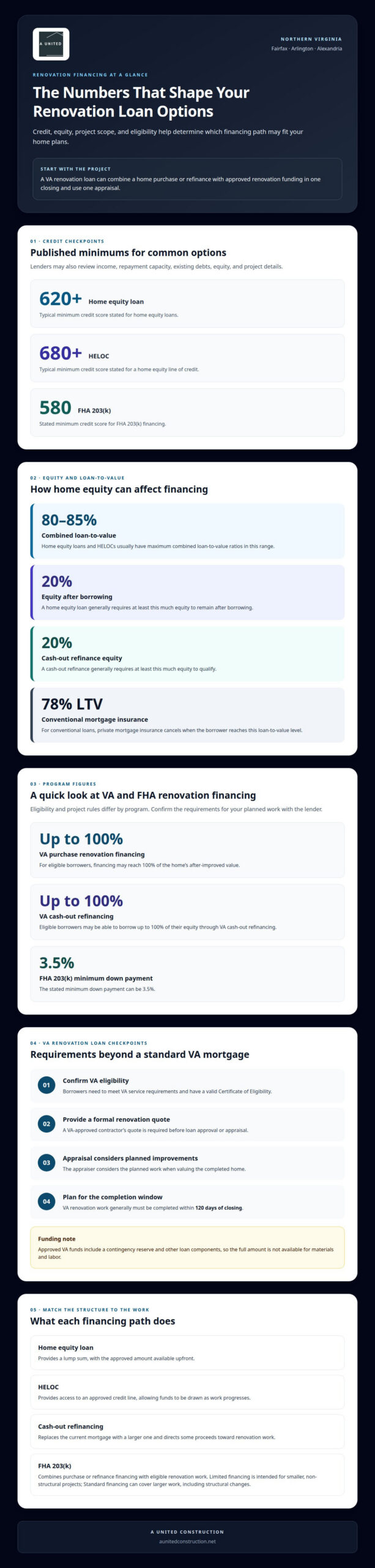
A home equity loan provides a lump sum, while a home equity line of credit lets you draw funds as work progresses. For a kitchen renovation completed in stages, a HELOC can align borrowing with the project schedule; a fixed loan makes the approved amount available upfront. Home equity loans and HELOCs usually have maximum combined loan-to-value ratios of 80-85%, and a home equity loan generally requires at least 20% equity after borrowing.
Virginia renovation permits are issued by local county and city building departments under the Virginia Uniform Statewide Building Code, with inspections at different stages of construction. The Virginia Department of Professional and Occupational Regulation licenses contractors as Class A, B, or C, depending on project size and value.
The program targets households earning below 50% of area median income. Financing a home renovation in Virginia may therefore involve comparing mortgage-based options with assistance programs that have specific household and repair eligibility requirements.
Renovation Loan Eligibility and Amounts
Eligibility connects your repayment profile to the home’s value and planned work. Home equity loans typically require a credit score of 620 or higher; HELOCs generally require 680 or higher. Lenders also review income, credit, available equity, and project details. For conventional loans, private mortgage insurance cancels when the borrower reaches 78% loan-to-value. These factors shape the loan amount available for the renovation.
VA and FHA Renovation Loan Processes
A VA renovation loan combines purchase or refinance financing with renovation funds in one closing and uses one appraisal. Borrowers need to meet VA service requirements and have a valid Certificate of Eligibility. A formal renovation quote from a VA-approved contractor is required before loan approval or appraisal, and the appraiser considers the planned improvements when valuing the completed home. FHA 203(k) financing can require a minimum down payment of 3.5%.
What are the requirements for renovation loans?
The main options include home equity loans, HELOCs, cash-out refinancing, and FHA 203(k) financing. Lenders review credit, income, equity, property value, and the proposed work before setting a loan amount.
Home Equity Borrowing Options
A home equity loan provides a set amount, while a HELOC lets you draw from an approved credit line. Both use your home’s equity, so the available amount depends partly on its value and existing mortgage balance. Home equity loans typically require a credit score of 620 or higher; HELOCs generally require 680 or higher. Income and repayment capacity also factor into approval.
Cash-Out Refinancing for Renovations
Cash-out refinancing replaces your current mortgage with a larger one and directs some proceeds toward renovation work. It differs from a home equity loan or HELOC because it changes the primary mortgage, not just the borrowing secured by the property. A cash-out refinance generally requires at least 20% equity to qualify. VA cash-out refinancing may allow eligible borrowers to borrow up to 100% of their equity.
Credit, Income, Equity, and Property Requirements
Renovation loan reviews connect your repayment profile with the home’s value and the planned improvements. Lenders assess credit, income, existing debts, equity, and property details to determine eligibility and loan amount. For conventional financing, Fannie Mae HomeStyle renovation costs are limited to 75% of the home’s expected value after renovation. Renovation loans may also require a contingency reserve of 10-20% of the renovation budget.
FHA 203(k) Financing
An FHA 203(k) loan combines financing for a home purchase or refinance with eligible renovation work. The stated minimum credit score is 580, and the minimum down payment can be 3.5%. FHA 203(k) Limited financing is intended for smaller, non-structural projects, while Standard financing can cover larger work, including structural changes. This distinction helps match the loan structure to the repairs or updates in your project plan.
How VA renovation loans differ from standard VA mortgages
A standard VA mortgage finances an eligible home purchase or refinance. A VA renovation loan also includes approved improvement work. That added scope changes the application, contractor documentation, funding process, and appraisal.
Comparing Renovation Loan Programs
VA, FHA 203(k), Fannie Mae HomeStyle, and Freddie Mac CHOICERenovation programs combine home financing with renovation funds, but differ in eligibility and project rules. FHA 203(k) offers Limited and Standard pathways, while HomeStyle and CHOICERenovation are conventional options. Eligible VA borrowers may purchase with no down payment, subject to program requirements. Compare each program against your service eligibility, project scope, and whether the work affects the home’s structure.
Benefits and Drawbacks of VA Renovation Loans
A VA renovation loan can combine the mortgage and approved improvements, which may suit eligible borrowers planning upgrades alongside a purchase. It also brings added requirements: borrowers need VA service eligibility and a valid Certificate of Eligibility. Few lenders offer this loan type, and its renovation work generally must be completed within 120 days of closing. Approved funds also include a contingency reserve and other loan components, so the full amount is not available for materials and labor.
Renovation Loan Funding and Appraisals
Unlike a standard VA mortgage, a renovation loan application requires a formal work quote from a VA-approved contractor before approval or appraisal. For projects involving specialized surfaces such as garage, basement, or porch upgrades, consulting professional installers like Masterclass Epoxy Floors & Training can provide clear cost estimates and material specifications for lender review. The appraiser evaluates the home based on the proposed improvements and inspects it again after the work is complete. The lender controls how renovation funds are used, so they aren’t unrestricted cash at closing. A detailed work scope helps connect the appraisal, approved improvements, and construction plan.
Rates, Fees, Repayment, and Tax Implications
Cash, credit cards, and renovation mortgages affect household finances in different ways. Paying cash avoids a new loan balance, while credit card borrowing uses revolving credit; a renovation mortgage ties repayment to your home loan. Compare repayment schedules and how borrowing would change your existing mortgage before choosing. Tax treatment depends on individual circumstances, so don’t assume renovation borrowing will create a tax benefit.
Cash-out refinancing
Cash-out refinancing replaces your existing mortgage with a new loan and makes some of your available equity accessible for renovations. It may suit homeowners who already own a home and want to fund updates without a separate home equity loan or line of credit. The new mortgage pays off the old balance, and the remaining proceeds can fund planned work.
Start by comparing the proposed mortgage terms with your current loan. The lender reviews income, credit, property value, existing debt, and the requested loan amount. A cash-out refinance generally requires at least 20% equity to qualify. An appraisal helps establish value, while your mortgage balance and eligible borrowing limit affect the proceeds available after payoff.
This differs from financing renovations as part of a home purchase. A purchase renovation loan combines the purchase and eligible improvements at closing; cash-out refinancing starts with a home you already own. It may be an option for a kitchen renovation, repairs, or structural updates, but the lender’s program determines which work qualifies. Aligning the renovation scope with the available funds helps keep the financing plan practical.
VA cash-out refinancing may allow eligible borrowers to borrow up to 100% of their equity. A VA renovation refinance has distinct limits: its loan-to-value ratio must be 90% or less, and the borrower must have lived in the home for at least 12 months. These are program-specific requirements, not a general rule for every cash-out refinance. Buying a home with renovation funding follows a different application path.
Before proceeding, compare the new mortgage’s interest rate, repayment period, and total balance with your current loan. Consider whether the renovation’s planned improvements justify changing the mortgage, and coordinate the funding timeline with the contractor’s project schedule. For a renovation that changes how your household uses its space, plan your home renovation scope before finalizing financing.
A United Construction: Home Additions
A United Construction helps homeowners define renovation projects clearly, making it easier to consider the planned improvements alongside financing decisions. If your home needs more functional living space, Home Additions can be tailored to your household, existing layout, and long-term needs.
For projects focused on existing rooms or outdoor living, Kitchen Remodeling, Bathroom Remodeling, and Deck Remodeling can address how you use your home. Defining the work, materials, and construction sequence helps establish a practical plan before work begins. This clarity can also help align the proposed scope with the funding structure you’re considering, whether you’re expanding your home or improving a kitchen, bathroom, or deck.
Contact A United Construction to discuss your renovation plans and how you want your home to work for you.
Shape your renovation around what matters next
Before choosing a financing option, define what you want to change and how each improvement will support your daily routines. A kitchen reconfiguration, finished basement, or bathroom update may call for different decisions about layout, materials, and construction sequence. For homeowners planning specialized features such as climate-controlled wine storage or entertainment areas, design guides and equipment recommendations from Rosehill Wine Cellars can help clarify space and appliance requirements early in the budgeting process. Connecting the work plan to how you’ll use the space gives financing a practical purpose, rather than letting the available loan dictate the renovation.
For homeowners financing a home renovation in Virginia, this planning stage connects design priorities with a workable construction scope. A United Construction brings those priorities into Kitchen Remodeling, Basement Remodeling, and Bathroom Remodeling, with close attention to function and lasting workmanship. A clear project direction can help you move from financing discussions to a home that better fits your life.
Discuss your renovation plans with A United Construction and take a confident next step toward the home you envision.
Frequently Asked Questions
What is a VA Renovation Loan?
A VA Renovation Loan is a mortgage option for eligible borrowers purchasing or refinancing a home that needs approved improvements. It may be relevant when the property’s condition or layout needs attention as part of the financing plan. The key distinction is that the renovation work must be defined for lender review, rather than treated as a separate project to plan after financing.
Q: What is a fixer upper loan in Virginia?
A fixer-upper loan is a general term for financing used to buy or refinance a home that needs repairs or upgrades. It isn’t a single loan product. In Virginia, available options depend on whether you’re buying or already own the property, the planned work, and the loan program’s eligibility rules. For a purchase, consider the property and intended improvements together.
How Does ARV Determine Loan Size?
ARV means after-repair value, the estimated value of a property after planned work is complete. It may help determine a program’s maximum financing, but it doesn’t establish how much a borrower will receive. Loan limits, borrower qualifications, existing mortgage debt, and the lender’s valuation process also matter. Treat ARV as one factor in the financing calculation, not a guaranteed loan amount.
Q: Can I be my own contractor for a remodel loan in Virginia?
Possibly, but a homeowner’s ability to manage the work and a lender’s approval of that arrangement are separate matters. Self-managing may involve scheduling trades, coordinating materials, and keeping the work within the approved scope. Before relying on this approach, identify the program’s contractor documentation requirements and project oversight rules. These can determine whether a self-managed plan is eligible.
Q: Is renovation financing in Virginia available for non-owner occupied properties?
Some financing options may accommodate investment properties, but eligibility depends on the loan product and intended use of the property. An investor planning repairs between tenants should distinguish purchase financing from borrowing against a property they already own. Occupancy status, borrower qualifications, and the proposed work can all affect which programs are available. Don’t assume a loan designed for an owner-occupied home also applies to a rental property.
What are current home equity loan and HELOC rates and fees in Virginia?
Rates and fees vary by lender, product, borrower profile, and loan terms, so no single quote applies to every Virginia homeowner. A HELOC may have a different rate structure from a home equity loan. Compare current lender disclosures, including how the rate is determined, when payments begin, and which fees apply. Review the full terms, not just the advertised rate.

