
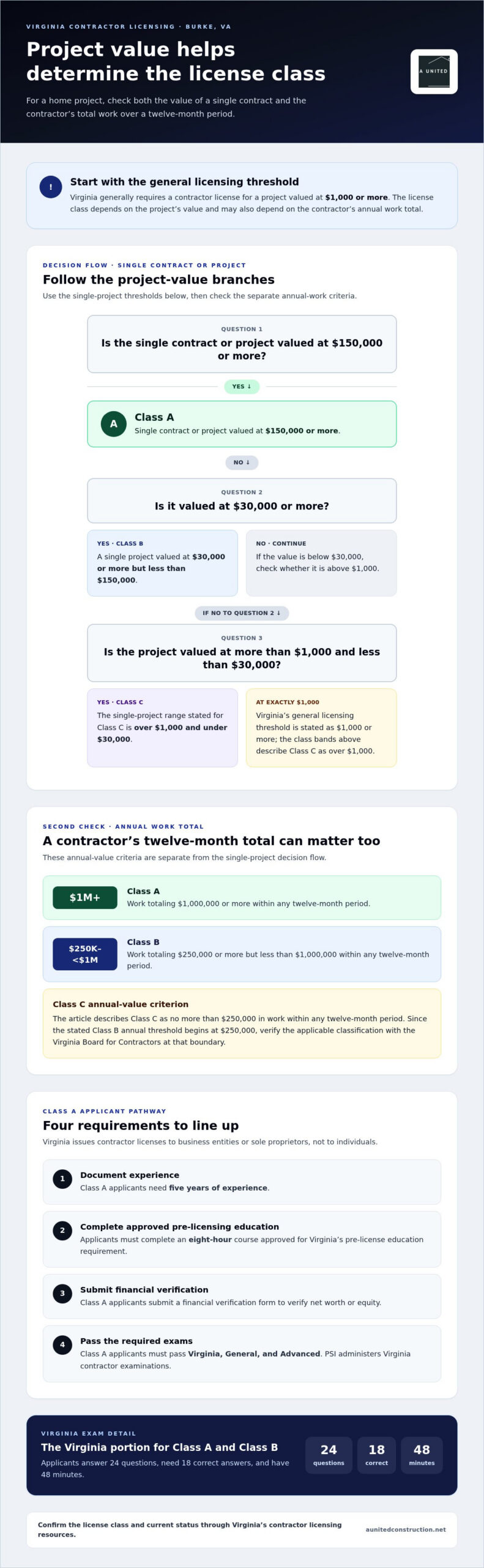
A Class A contractor serving Burke, VA, may perform or manage a single contract or project valued at $150,000 or more. According to the Virginia Board for Contractors, Class A also covers contractor work totaling $1,000,000 or more within any twelve-month period; Virginia generally requires a contractor license for projects valued at $1,000 or more.
Choosing a Class A contractor in Burke, VA, involves more than finding someone to complete the work. You also need to understand which license class fits your project and what credentials and insurance to review before construction begins.
This guide explains Virginia’s contractor license classes, the experience and application requirements for Class A applicants, and how to assess credentials for a home project in Burke. It also covers how the remodeling scope, permits, materials, and project sequencing shape the work, helping you plan a kitchen, bathroom, basement, deck, or addition with greater confidence.
Key Takeaways
- Understand how Virginia distinguishes contractor license classes by the value of a single project and the total work performed within a twelve-month period.
- Learn the experience, education, financial documentation, and exam steps relevant to Class A contractor applicants.
- Know which license and insurance credentials to review when assessing a contractor for home remodeling in Burke.
- Compare project proposals by checking the work scope, building permits, material selections, timeline, and project sequencing.
- See how a planned kitchen remodel can align construction decisions with your household’s daily needs and long-term goals.
What are the Requirements to Getting a Virginia Contractor License?
Virginia contractor licensing starts with the project’s value and the scope of work. According to the Virginia Board for Contractors, a contractor license is generally required for projects valued at $1,000 or more. According to the Virginia Board for Contractors, a Class C contractor may perform or manage a single contract or project valued at over $1,000 but less than $30,000. These thresholds help homeowners understand why a contractor’s license class matters before work begins.
Virginia classifies contractors as Class A, Class B, or Class C. A Class A contractor may perform or manage a single contract or project valued at $150,000 or more. According to the Virginia Board for Contractors, Class A contractor work totaling $1,000,000 or more within any twelve-month period also falls within the Class A definition. Class B applies to a single project valued at $30,000 or more but less than $150,000, or work totaling $250,000 or more but less than $1,000,000 within any twelve-month period. Class C contractors may undertake no more than $250,000 in work within any twelve-month period under the annual-value criterion.
Virginia issues contractor licenses to business entities or sole proprietors, not to individuals. Applicants select the class that matches the work they plan to undertake and complete its specific application requirements. Class A applicants need five years of experience; Class B applicants need three years, and Class C applicants need two years. Class A and Class B applicants also submit a financial verification form, choosing one of the available forms to verify net worth or equity. A Class A application therefore requires both documented experience and financial information.
Education and examinations are additional steps. Virginia contractor applicants must complete an eight-hour pre-licensing course. A basic business course may meet this requirement if it covers relevant regulations, statutes, and business-owner requirements. The course must be approved to satisfy Virginia’s pre-license education requirement; general business instruction alone is not enough.
Class A applicants must pass three required exams: Virginia, General, and Advanced. Class B applicants must pass two: Virginia and General. The Virginia portion for Class A and Class B has 24 questions, requires 18 correct answers, and allows 48 minutes. PSI administers Virginia contractor examinations. Applicants should match their application class, education, experience records, financial form, and examination plan before starting, so each step aligns with the license they intend to obtain.
Class A contract and annual project thresholds
For a Burke home project, the license class is just one part of planning the work. Make sure the written agreement defines the scope: which rooms or exterior areas are included, what is excluded, and how related tasks will be coordinated. This is especially useful when a renovation has several stages, such as redesigning a kitchen while updating adjacent living space.
Ask how changes will be documented after work begins. A clear process identifies who can approve a revision, how the scope will be updated, and how the change may affect the schedule. For example, choosing a different cabinet configuration can affect ordering and installation. Recording the decision in the project documents keeps everyone working from the same plan.
A useful project schedule connects tasks to practical milestones instead of giving only broad start and finish dates. Ask which decisions must be made before construction, when materials need to be selected, and which tasks depend on earlier work. In a bathroom renovation, finish installation follows preparation and necessary trade work. A schedule that shows these dependencies helps you plan household routines.
Read the workmanship warranty terms carefully. The agreement should explain which completed work is covered, how to report a concern, and what happens next. Keep the terms with your contract and approved revisions. A clearly written warranty gives you a reference if questions arise after the project is complete.
Reviews from Burke and nearby communities are most useful when they describe work like yours. Read the details, not just the rating. A kitchen renovation review might discuss communication during cabinet selection, while an exterior project review may describe site preparation or cleanup. Specifics help you understand how the contractor handled a similar project.
Look for patterns across reviews rather than treating one comment as decisive. Note whether customers mention clear updates, organized work areas, careful finish details, and timely responses to concerns. Reviews can help you prepare questions, but your written proposal is where you establish the project scope and expectations.
Before signing, read the agreement alongside the project plan. Confirm that the scope, decision process, schedule, and warranty language reflect what you discussed. Keep approved changes and project communications together, so details remain easy to track through completion. A clear home project planning approach can support that organized start.
Contractor credentials and insurance
A current Virginia contractor license is a starting point for evaluating a Burke home improvement project. Virginia DPOR provides a way to verify a contractor’s license status and classification. Compare the business name on the license record with the name on the proposal and contract. A mismatch can make it harder to determine which business entity is responsible for the work.
Check that the license remains current before work begins. In Virginia, an expired contractor license is no longer valid for engaging in contracting, and the 30-day renewal period after expiration does not extend the license. That distinction matters: a renewal grace period is not permission to continue contracting under an expired license. Confirm the status and class for the business entity named in your agreement.
Insurance is separate from licensing. Ask for a current certificate of insurance and review the named business, policy dates, and coverage categories. General liability may address certain third-party claims, while workers’ compensation relates to employee injuries. The certificate summarizes the represented policies but does not replace their terms. For a kitchen renovation, check that the named business and coverage dates align with the planned work period.
For exterior work, such as improving an entry or outdoor living area, clarify how the contractor’s insurance applies to the project site and the work described. Ask whether subcontractors are involved and how their coverage is documented. A written answer tied to your proposal is more useful than a general assurance. Keep the certificate and related project records with your signed agreement.
Use a consistent review sequence before approving a contract:
- Match the license holder’s business name to the proposal and contract.
- Confirm Virginia DPOR lists a current license in the appropriate class.
- Review insurance documentation for the named business and policy dates.
- Compare the written work scope with the project and any subcontractor roles.
Credentials support accountability, but they don’t demonstrate workmanship on their own. Review the license and insurance alongside a detailed scope, material specifications, required building permits, and a written schedule. For example, an exterior improvement proposal should identify the surfaces or structures included, the specified materials, and how changes will be recorded. These details reduce ambiguity from preparation through completion.
Keep the license information, insurance certificate, contract, and approved changes together. If the project changes substantially, revisit the written scope and current insurance documents before the revised work proceeds. This simple recordkeeping step gives Burke homeowners a clearer picture of who is responsible, what the agreement covers, and which documents apply.
Which Class A general contractors serve Burke, VA?
When looking for a Class A contractor in Burke, VA, consider firms serving Burke and nearby Fairfax County communities. A United Construction serves homeowners in Burke, Fairfax, Arlington, Alexandria, Springfield, Fairfax City, Reston, Chantilly, Herndon, Centreville, Lorton, McLean, Fair Oaks, and Fairfax Station. A local service area can make it easier to find a contractor familiar with the community, but the right fit still depends on your project’s needs and scope.
Start by identifying the work your home needs. A kitchen renovation involves coordinating cabinetry, countertops, fixtures, and construction stages. A home addition has a different scope, with decisions about connecting the new space to the existing floor plan. Deck and other exterior work require attention to how the structure relates to the home and how you plan to use the outdoor space. Look for experience relevant to your project, not just a broad specialty label.
Discuss how the contractor approaches projects like yours. For a kitchen renovation, ask how design choices are coordinated with construction planning. For an addition, talk about how the proposed space will connect with your existing layout. For exterior improvements, explain how you use the outdoor area and what the finished space needs to support. These conversations help establish whether the contractor understands your priorities.
Local knowledge can inform practical planning. A Burke project has its own site conditions, household routines, access needs, and material-delivery considerations. Discuss how the contractor will organize site preparation, communicate construction updates, and coordinate work around your home’s use. A useful response addresses your actual property and project, not just a general list of services.
As you compare contractors in Burke, Fairfax, Arlington, Alexandria, and nearby communities, look for clear descriptions of the residential work they perform. Reviews about projects similar to yours can provide useful context. For a bathroom renovation, comments about coordinating finishes may be more relevant than a review of an unrelated exterior project. Focus on concrete examples of completed work and communication, not just general praise.
Before deciding, consider whether the contractor’s specialties match your plans and whether the project discussion addresses your home’s needs. A firm may serve Burke, Fairfax, Springfield, or other nearby communities, but location alone doesn’t establish the right fit. Choose based on how clearly the contractor understands the work and explains the path from planning through completion.
How can I get and compare quotes from Class A contractors in Burke, VA?
Prepare a written project brief for each contractor you approach in Burke. Describe the rooms or exterior areas involved, the changes you want, and how your household uses the space. For a kitchen, note storage needs, traffic flow, cabinet preferences, and countertop material. For a deck, describe its intended use and connection to the home. Sharing consistent details helps each contractor prepare a proposal for the same scope.
Share relevant plans, photos, and known site conditions. Identify features that must remain and decisions you’re still weighing. If the project involves moving walls, plumbing, or electrical elements, include that in your brief. The contractor can then explain how those details affect design, permits, material coordination, and sequencing. Ask for the proposed work to be described in writing rather than relying on broad labels such as “full remodel.”
Request proposals that identify included work and exclusions. Then compare the documents side by side:
- Scope: Does each proposal describe the same rooms, surfaces, and construction tasks?
- Materials: Are selections or allowances explained clearly enough to compare?
- Preparation: Does the plan address protection, access, and site preparation?
- Schedule: Are project stages and dependencies described?
- Changes: Does the proposal explain how revisions are documented and approved?
- Closeout: Does it describe cleanup, final review, and warranty terms?
Review differences before choosing. One Burke proposal may include demolition and disposal, while another leaves those tasks outside its scope. A kitchen proposal might describe cabinet installation without identifying the countertop material. Clarify each gap in writing so the proposals cover comparable work. This keeps your decision from resting on a headline number or polished presentation alone.
Discuss the sequence with each contractor. Ask when design decisions must be final, how material deliveries fit the schedule, and which tasks depend on inspections or completed work. A practical schedule identifies key milestones without implying that every stage can proceed independently. Clear communication about decision points helps you plan household routines during construction.
Before signing, read the complete agreement and compare it with the final proposal. Confirm that the business name, scope, payment milestones, change process, schedule, and warranty terms match your understanding. Keep approved revisions with the agreement. If a detail changes during planning, have the written documents updated before work proceeds.
Prepare a project brief and request a renovation proposal that sets out your goals, priorities, and planned scope.
A United Construction: Kitchen Remodeling
A United Construction is a natural next step when your Burke home project calls for careful planning and coordinated construction. For a kitchen remodel, the process can connect cabinet selection, countertops, layout decisions, and construction sequencing to how your household uses the space. The goal is a kitchen that supports daily routines and your home’s long-term function.
For other projects, A United Construction also provides bathroom remodeling, deck remodeling, and home additions. Clear goals help guide decisions about materials, permits, and how construction may affect everyday life. A United Construction is a Class A licensed contractor serving Northern Virginia and Washington, D.C., with a focus on craftsmanship and communication throughout the project.
To discuss your home project, contact A United Construction or visit aunitedconstruction.net.
Shape Your Next Home Project With Confidence
A renovation is an opportunity to make your home work better for the way you live. As you consider a Class A contractor in Burke, VA, bring your priorities to the first planning conversation: what feels limiting today, how you want each space to function, and which details matter most for lasting use. A clear vision gives design and construction decisions a practical foundation.
A United Construction offers kitchen remodeling, basement remodeling, and bathroom remodeling for homeowners planning changes to their living spaces. Whether you’re refining a kitchen layout, improving an underused basement, or reworking a bathroom, the next step is to discuss your project’s goals and scope.
Contact A United Construction to begin a conversation about your home renovation. With a clear plan, you can move forward with greater confidence and create spaces that feel more considered, comfortable, and useful.
Frequently Asked Questions
What type of work can be done with this license?
A Virginia Class A license covers contracting work within the firm’s approved classification and specialties. For homeowners, the practical question is whether the proposed tasks fall within that scope. If a renovation combines structural changes, finish work, and several construction stages, ask the agreement to identify the work the licensed firm will perform or manage. This makes the license scope easier to compare with the actual project.
What does a Virginia Class A contractor license allow?
A Class A license authorizes the business to perform or manage contracting work within its Virginia classification and specialties. It is a regulatory credential, not a description of every service or task the business can take on. Read the proposed scope alongside the license classification and specialty to distinguish the contractor’s authorization from design choices, workmanship standards, and the specific commitments in your agreement.
How can I verify a contractor’s Class A license in Virginia?
Use Virginia DPOR’s public license lookup to review the contractor’s record. Note the listed classification and status, and save the record with your project documents. If your project start date or the contractor’s business details change before signing, review the record again. Keeping a dated copy gives you a clear reference for the license information considered during your selection.
What types of projects require a Class A contractor in Virginia?
Virginia’s Class A classification applies when a project or the contractor’s qualifying work meets the Class A value criteria. The room or project label alone, such as “kitchen remodel” or “deck,” doesn’t determine the class. For a project with several components, review the complete written scope to understand the contracted work. The project-value limits discussed above provide the criteria for determining when Class A applies.
What are Virginia’s Class A contractor licensing requirements?
Applicants must meet Virginia’s class-specific requirements before receiving a Class A contractor license. The process involves aligning the business application with the required experience, education, financial documentation, and exams. Organize those records together and ensure they refer to the same applicant and intended classification. This helps keep the application materials consistent throughout the licensing process.
How do Burke, VA Class A contractors compare by reviews and specialties?
Compare contractors by the project work they describe, not by specialty labels alone. A renovation that changes room layouts, for example, calls for different planning experience than a project focused on finish updates. In reviews, look for details about how similar work was completed. Treat ratings as one reference point, then assess each firm’s written proposal against your project requirements.

