
Five questions to ask a general contractor should cover references, licensing and insurance, payment milestones, communication, and the project schedule. Start by requesting references from a past client, an architect, and a subcontractor, then ask how the contractor will keep work coordinated and share updates. These answers can help you assess how the project will be managed, not just how it is expected to look when complete.
It’s reasonable to want clear expectations before construction begins. Ask to see completed projects, identify your main point of contact, and learn how schedule changes or delays will be communicated. A written agreement that defines project milestones and payment terms also helps keep everyone aligned.
This guide explains what to look for in answers about qualifications, insurance, references, payment timing, communication, and plans for delays. With these details, you can compare proposals more thoughtfully and begin a remodeling project with a clearer understanding of the process.
Key Takeaways
- Request references from a past client, an architect, and a subcontractor to learn how the contractor handles different working relationships.
- Review licensing and insurance details so you understand who is responsible for the work and covered on the project.
- Ask how payments align with completed project milestones, and make sure the schedule is clearly documented.
- Agree on a primary point of contact and how often you’ll receive progress updates.
- Set expectations for the start and finish dates, possible schedule impacts, and how changes or delays will be communicated.
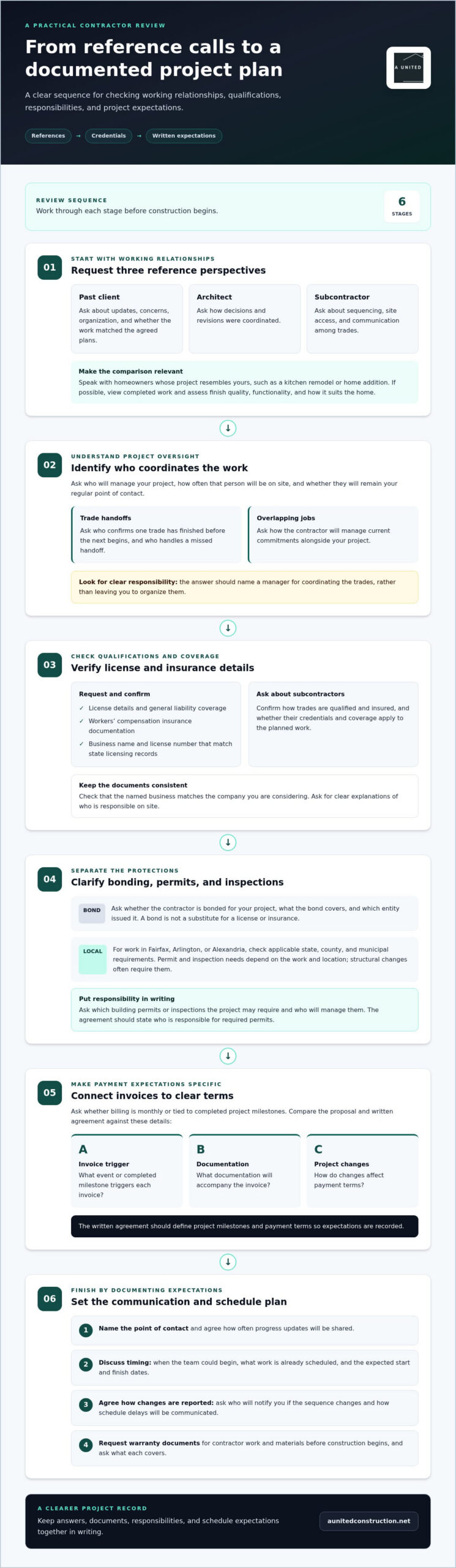
1. Can you provide a list of references, ideally from a client, architect, and subcontractor?
Ask for references from three perspectives: a past client, an architect, and a subcontractor. Each can describe a different part of the working relationship, from day-to-day communication to coordination between trades. Speak with homeowners whose projects resemble yours, such as a kitchen remodel or home addition, rather than relying only on examples with a different scope.
Use specific questions to make each conversation useful. Ask the former client how often the contractor shared updates and whether the work matched the agreed plans. Ask the architect how decisions and revisions were coordinated. Ask the subcontractor how the contractor handled sequencing, site access, and communication when several trades needed to work in the same area.
References can also help you understand current workload and project management. Ask who will manage your project, how often that person will be on site, and how the contractor will handle overlapping jobs. Owner-managed builders such as Golden Hammer Construction emphasize hands-on site supervision to direct trades, monitor quality, and communicate with the client throughout the project. Clarify whether that supervisor will remain your regular point of contact.
Subcontractors often handle specialized work, so ask how their tasks will fit together. A kitchen renovation, for example, may involve cabinet installation, electrical work, and finish carpentry. Ask who confirms one trade has finished before the next begins, and who handles a missed handoff. The answer should identify a responsible manager, not leave you to coordinate the trades.
Compare the contractor’s current commitments with your project’s expected timeline and payment schedule. Ask when the team could begin, what work is already scheduled, and who will notify you if the sequence changes. References can explain whether schedule updates were clear during their projects. In Fairfax, Arlington, and Alexandria, ask about similar work in nearby homes, then compare those examples with your project scope, finish details, and daily needs.
2. Are You Licensed, Insured, and Bonded?
Ask for the contractor’s license details, general liability coverage, and workers’ compensation insurance. Compare the business name and license number with state licensing records, then confirm the documents apply to the work you’re planning. For a kitchen project, ask whether the contractor’s credentials cover the work and whether subcontractors have appropriate qualifications and insurance.
Insurance helps clarify who may be responsible if work-related damage or an injury occurs. Ask for documentation of liability and workers’ compensation coverage, and check that the named business matches the company you’re considering. Ask how subcontractors are covered, too. The general contractor should explain how trades are qualified and insured so you know who is responsible on site.
Bonding is a separate point to clarify. Ask whether the contractor is bonded for your project, what the bond covers, and which entity issued it. A bond is not a substitute for a license or insurance; each serves a different purpose. A clear answer identifies the relevant document and explains how it relates to your renovation.
Licensing and permit requirements vary by state and locality. In Fairfax, Arlington, and Alexandria, check applicable state, county, and municipal requirements for your project, since the work and location can affect what applies. Ask which building permits or inspections the scope may require and who will manage them. Structural changes often require permits or inspections, though requirements vary by project.
Red flags include refusing to provide license or insurance details, giving documents with a different business name, or avoiding clear answers about subcontractor coverage. Pressure to proceed without written responsibilities for permits is another reason to pause and clarify the agreement before work begins.
Before signing, ask how licensing, permits, inspections, and warranty documents will be handled. The contractor should explain the permitting and inspection process, and the contract should state who is responsible for required permits. Request copies of any contractor-work and material-manufacturer warranties before construction begins, and ask what each covers. A written explanation makes the protections applying to the finished work easier to understand.
In Virginia, a Class A licensed and insured contractor can explain how credentials and coverage relate to the planned work. Ask who will serve as project manager and handle questions about documentation during construction. For a clearer view of how planning and oversight fit together, review the remodeling project process.
Requirements depend on the state and locality, as well as the project’s work and location, so check applicable state, county, and municipal rules. Permit and inspection needs vary by project. Structural changes commonly require them, and the contractor should clarify which steps apply and who will manage them.
3. What is your payment schedule?
Ask whether billing will be monthly or tied to completed project milestones. Compare what triggers each invoice, what documentation you’ll receive, and how changes affect payment. When comparing pricing methods and fees, focus on how each proposal defines the scope, billing method, and included work, rather than comparing a single headline figure.
Clarify the deposit before hiring. Ask what it covers, when it is due, and how later payments relate to completed work. The Better Business Bureau advises homeowners not to pay contractors the full amount upfront. Before work begins, the remodeling agreement should clearly state the deposit, progress payments, and final payment.
Ask for the payment schedule in writing, with each installment tied to an identifiable stage. For example, a kitchen project might link an invoice to completed demolition or cabinet installation, if those stages appear in the agreed plan. Clear milestones help you compare the work completed with the payment requested and give both parties a shared reference if a stage changes.
Budget control belongs in the contract, too. Ask how changes to the scope will be documented and whether written approval is required before extra work begins. The contractor should not exceed the agreed budget without your approval, and the contract should say so. Request an itemized bill showing the factors contributing to the final amount, rather than a single unexplained balance.
Clarify what happens if work is delayed, materials change, or an invoice is disputed. Ask whether payment is due on a calendar date or when a defined stage is complete. If a milestone remains unfinished, the agreement should explain how the next payment is handled. Record changes to scope, timing, and payment terms in writing rather than relying on verbal agreements.
Ask how the final payment will be documented. A written lien waiver can verify payment and waive the contractor’s rights to file a lien on the property. At project completion, a lien waiver stating that you’ve paid in full is considered the gold standard. Confirm when the waiver will be provided and keep it with the contract, invoices, and records of completed work.
Before signing, review the payment schedule alongside the project timeline. Check that each payment has a clear due date or completion trigger, and that the contract explains who approves changes. This helps you understand what you’re paying for at each stage and how payment relates to completed remodeling work.
4. Communication and points of contact
Ask who will handle communication once work begins. Identify the person who can answer questions, coordinate trades, and relay decisions to the crew. A project manager may handle scheduling while a site supervisor oversees daily work. Clarify who can approve routine adjustments and who will bring significant changes to you before work proceeds.
Agree on the communication method and update rhythm upfront. Ask whether progress reports will arrive by email, phone, or a project platform, and whether they’ll include site photos. Weekly updates, regular meetings, or photos can help you follow the work. Set a consistent day for updates if it suits your household and project plan.
Discuss response expectations directly. Ask how the team handles routine questions, urgent site concerns, and decisions that could affect the work sequence. Agree on a practical process rather than assuming a response time, such as naming a backup contact when the main manager is unavailable. A clear route helps you direct questions about the work, access, or material deliveries.
Decision deadlines matter when selections affect the next construction step. For example, a countertop choice may need to be settled before ordering or installation can proceed. Ask the manager to identify upcoming decisions, explain what information you’ll need, and give you a clear date for each response. This allows time to consider design and function while helping the crew plan dependent tasks.
Agree on a written record for changes. After discussing a revised detail, ask for a brief summary stating what changed, who approved it, and whether it affects the schedule or scope. If a lighting location shifts during a kitchen renovation, for example, written confirmation helps the electrician and finish team follow the same direction and gives you a reliable reference later.
Use the interview to assess the contractor’s communication style. A clear, direct answer about updates or approvals can show how the team approaches client communication. Notice whether the contractor listens, addresses your specific concern, and explains the next step without leaving you to interpret technical details. That conversation offers an early example of how the team may organize information.
Before work starts, record the main contact, backup contact, update method, meeting plan, and process for decisions. Keep those details with your project documents and use the same channel for follow-up. A simple protocol prevents scattered messages and gives you and the manager a shared place to track questions, approvals, and material selections throughout construction.
5. Construction timelines and delays
Ask the contractor to put expected start and completion dates in writing. Useful questions to ask a general contractor include what could affect the schedule and how updates will reach you. A timeline should connect construction stages, deliveries, inspections, and your decisions. For a home addition, ask how site preparation, structural work, and interior finishes fit together, and which stages depend on earlier work.
How will the contractor manage the timeline, delays, and change orders? Agree on planned start and end dates, likely schedule impacts, and a clear method for sharing updates. Ask for written change orders that explain the adjustment, its effect on the sequence, and any revised completion date before approving the work. That record helps you understand what has changed and what comes next.
Look beyond the final date. Request a schedule that shows the order of major tasks and which work depends on each step. In a bathroom renovation, rough plumbing must precede wall finishes, while a delayed material delivery could affect later installation. Understanding these connections shows why one change may move several activities. Ask the contractor to explain schedule dependencies in plain language.
Ask which decisions you need to make and when they’re due to protect the schedule. A custom tile layout, fixture selection, or cabinet choice can affect ordering and installation. Ask the contractor to flag decision deadlines early and explain what work could pause if a selection arrives late. This gives you time to consider options and helps the crew plan dependent tasks.
Clarify how progress will be measured and reported. Regular updates should identify completed work, upcoming tasks, and obstacles affecting the sequence. If an inspection or delivery changes the next scheduled activity, ask who will tell you, what task follows, and whether the completion date needs revision. Specific updates are more useful than general assurances that work is progressing.
One useful question to ask a general contractor concerns overlapping trades and rescheduled work. Ask who will revise the schedule if a subcontractor cannot start as planned, and how the team will prevent one delay from disrupting unrelated tasks. The project manager should explain the revised order and the reason for the change so you can understand its practical effect on your household.
Keep the agreed timeline, updates, and approved changes together with your project documents. When a schedule changes, compare the new dates with the remaining tasks and ask what decisions or access the crew needs next. If you’re planning a home addition, discuss your addition project with a team that can guide planning and construction.
A United Construction: Kitchen Remodeling
A United Construction helps homeowners create well-coordinated spaces through Kitchen Remodeling, Bathroom Remodeling, Deck Remodeling, and Home Additions. Once you’ve clarified your expectations for references, qualifications, payment milestones, communication, and scheduling, discuss how those priorities apply to your home.
For a kitchen project, that conversation can connect your daily routines with decisions about the floor plan, cabinets, countertops, and construction sequence. Clear planning aligns design choices with functionality and the work required to complete the renovation. Homeowners considering a bathroom update, deck project, or home addition can also discuss the scope and planning needs of their project.
Contact A United Construction to discuss your remodeling plans and the next steps for your project.
Turn Your Renovation Priorities Into a Clear Plan
Start by defining what a successful renovation should change about everyday life at home. Consider how your household uses the space, what feels difficult now, and which improvements matter most. This gives your first project conversation a practical starting point and connects design choices with function, durability, and the way you want to live.
Questions to ask a general contractor are most useful when they lead to a shared understanding of your priorities. A United Construction works with homeowners on Kitchen Remodeling, Basement Remodeling, and Bathroom Remodeling, shaping each project around the home and the intended use of the space. Bring your goals and any relevant plans to a conversation about next steps.
Contact A United Construction today to discuss your renovation plans. A thoughtful first step can help you move forward with greater clarity and confidence.
Frequently Asked Questions
Can you provide a list of references, ideally from a client, architect, and subcontractor?
References are most useful when they reflect the full project relationship. Ask a former client, an architect, and a subcontractor about communication, coordination, and how concerns were handled. For a kitchen renovation, a client can describe living through the work while an architect can discuss design coordination. Compare these accounts with completed projects that match your scope and finish priorities.
How do you communicate with clients?
Clear communication gives you a dependable way to understand decisions and next steps. Before work begins, establish who manages the project, how updates are shared, and how approvals are recorded. For example, a written note after a fixture selection can prevent confusion between your decision and the installation team’s instructions. A United Construction emphasizes personal project management and clear planning throughout residential remodeling.
How long does your warranty on the work last?
Any warranty coverage and duration should be stated in writing before construction begins. Ask what workmanship coverage includes, when it starts, and how to report an issue. Distinguish contractor workmanship coverage from material-manufacturer warranties, since they apply to different parts of the project. Keep warranty documents with your agreement and completion records so you can refer to the terms later.
How many projects like mine have you completed?
A United Construction has completed more than 500 projects, but the total alone doesn’t show how closely its experience matches your renovation. Ask about examples with a similar scope, such as a bathroom reconfiguration or a kitchen with changed cabinet locations. Discuss the project’s challenges, finished functionality, and coordination needs. Homeowners in Fairfax, Arlington, and Alexandria can use those details to assess relevance to their own homes.
What is your payment schedule?
The payment schedule should be documented in your written agreement and tied to clear due dates or completed stages. A United Construction uses fixed-price or cost-plus contracts; ask how your agreement defines billing, approved changes, and payment milestones. Confirm what work must be complete before a progress payment is due. Keep invoices and change approvals with the contract for a clear record.
Will you handle the permitting and inspection process?
Clarify who coordinates permits and inspections and how those steps fit the schedule. Requirements depend on the project and locality, so the scope and property location matter. A United Construction includes permitting in project planning. Ask how inspection milestones will be communicated and what work must be ready beforehand to understand how the process connects with construction progress.
Are you licensed for this type of project?
A United Construction is a Virginia Class A licensed contractor, with Virginia license number 2705140752 and Washington, D.C. license number 410521000698. Its stated service areas include Fairfax, Burke, Chantilly, Centreville, Woodbridge, Ashburn, McLean, Alexandria, Annandale, Arlington, Tysons, Lorton, Springfield, Manassas, Reston, Washington DC, Mount Vernon. Match the relevant license and project scope with the location where work will take place.
Are you licensed, insured, and bonded?
A United Construction states that it is Class A licensed and fully insured. Licensing and insurance are distinct from bonding, so ask what documentation applies to your project and review the agreement for the responsible contracting entity. For a renovation in Northern Virginia or Washington, D.C., confirm that the business name on project documents matches the licensed contractor. Keep copies of applicable credentials with your signed contract.

