
A renovation doesn’t pause family life while the work gets done. The most useful living through a home renovation tips start with planning for both: which rooms and facilities will stay usable, where belongings can be protected, and how household routines may need to change as work progresses.
It’s reasonable to have questions about dust, noise, privacy, schedule changes, and the effect on workdays, meals, or pets. A thoughtful plan can’t prevent every disruption, but it can make decisions easier when conditions shift. Agreeing on access, work areas, and project updates also helps everyone understand what to expect.
This guide explains how to prepare your home, establish practical routines, and plan for changing conditions during construction. You’ll learn how to consider temporary arrangements, protect personal spaces, and coordinate daily life with project sequencing. When design and construction planning reflect how you use your home, renovation can feel more manageable from preparation through completion.
Key Takeaways
- Use these living through a home renovation tips to map work areas, household routines, and communication before construction begins.
- Plan how to protect belongings and manage noise, dust, privacy, and rooms that may be temporarily unavailable.
- Understand how material coordination and project sequencing can affect access to rooms and pathways.
- Distinguish an adjustment to project sequencing from a confirmed change in project scope.
- See how connected design, construction, and project management can help align renovation decisions with daily life.
Living Through a Home Renovation: What to Expect Day to Day
Looking forward to a finished kitchen, bathroom, or basement doesn’t make the construction phase effortless. Excitement and disruption can exist side by side, especially when work affects familiar spaces and routines. An occupied renovation is construction carried out while residents continue living at home.
Day to day, you may need to plan around room access, construction noise, dust, privacy, material deliveries, and changes to where or when household activities happen. The Home Improvement Overview offers broad context on renovation projects; for everyday planning, your home and project details matter most. Disruption depends on project scope, work areas, project sequencing, and household needs. Start by picturing a typical weekday and identifying where each essential activity can happen.
- Where will you prepare meals if the kitchen is being remodeled?
- Which bathroom will remain accessible, and when?
- Where can children, pets, or household members work, rest, or take private calls?
- How will deliveries reach the work area without blocking a regularly used route?
Access may change as construction progresses. A room that is available during one stage may be needed later for materials or work. Identify the areas that could be affected so you can make realistic plans instead of relying on a fixed picture of each day.
Which parts of the home may be affected?
A kitchen project can change where meals are prepared and dishes are washed. A bathroom remodel may affect morning and evening routines, while basement work can alter access to storage, laundry, or a route through the house. Whole-home renovations can involve several spaces at different stages. Map essential activities, such as cooking, bathing, working, and letting pets outside, to areas expected to remain accessible. During planning, discuss room access and project sequencing so the household understands when a room or pathway may be needed.
Can you stay home during renovation work?
There isn’t a single answer. Consider which facilities will remain available, how much of the home will be an active work area, and whether household members need quiet, privacy, or a predictable place to work. A project in one contained area may present different considerations from work affecting several rooms. Family circumstances matter, too, including children, pets, health needs, and work schedules. Discuss safety, access routes, and boundaries between living and construction areas with the project team, then weigh the practical arrangements against your household’s needs.
Planning is strongest when design choices and construction activity are considered together. A clear picture of daily needs gives the project team useful context for coordinating the work, while leaving room to adapt as conditions change.
How to Prepare Your Home Before Renovation Begins
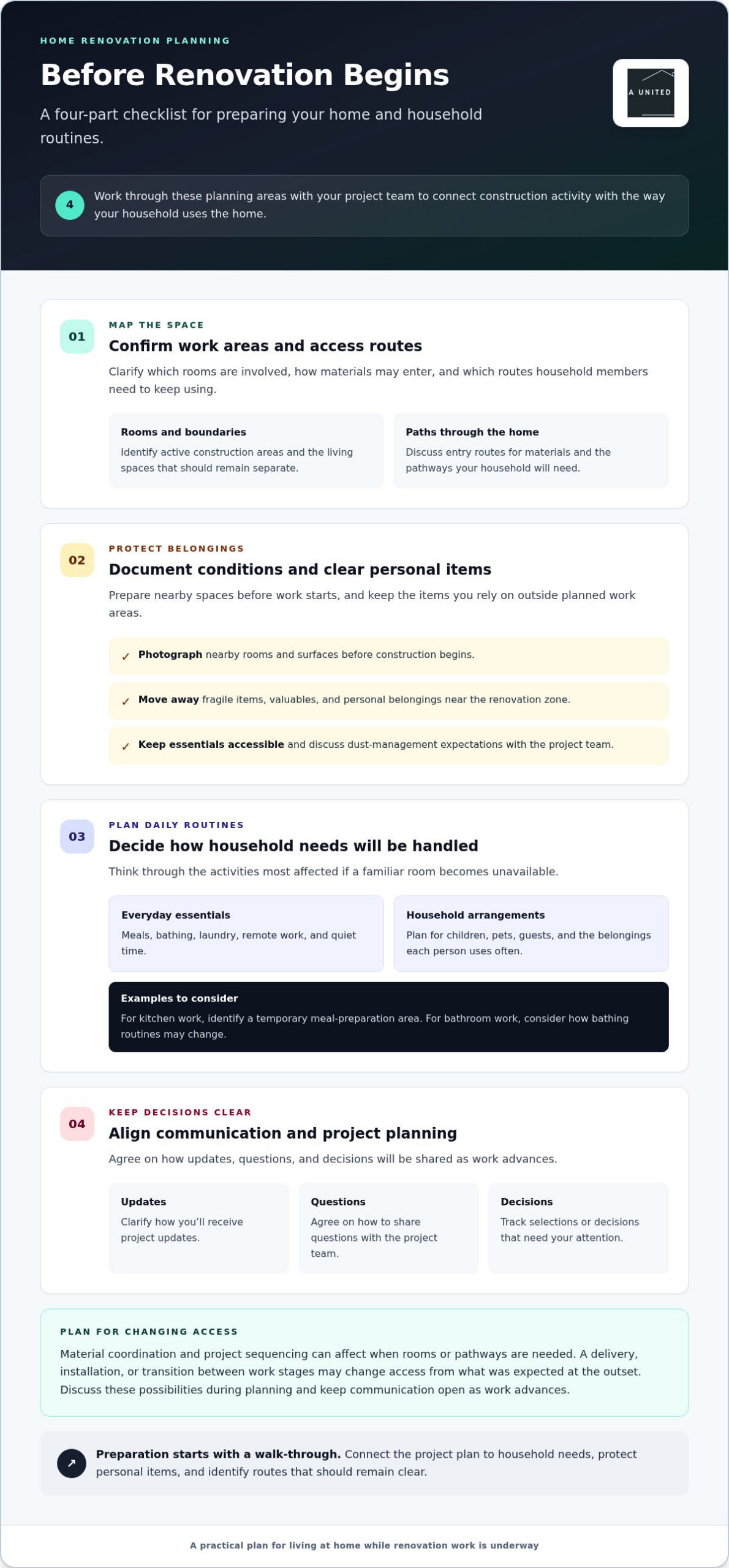
A considered preparation plan gives your household a clearer starting point before construction begins. It also helps the project team understand how the home functions, which areas need to stay accessible, and what could affect work in progress. Four tasks set the stage: confirm work areas, clear and document belongings, plan temporary routines, and agree on how to communicate.
Work through this sequence with your project team:
- Confirm work areas and access routes. Identify the rooms involved, where materials may be brought in, and which paths household members will need to use. Clarify boundaries between active construction areas and living spaces.
- Document conditions and clear belongings. Photograph nearby rooms and surfaces before work starts. Move fragile items, valuables, and personal belongings away from planned work areas, and keep essential daily items easy to reach.
- Plan household routines. Decide how you’ll manage meals, bathing, laundry, remote work, and quiet time if a familiar room becomes unavailable. Include practical arrangements for children, pets, and guests.
- Align communication and decisions. Establish how you’ll receive project updates, share questions, and track selections or decisions that need your attention. Keep a short list so important items don’t get lost in day-to-day demands.
Material coordination and project sequencing can influence when rooms or pathways are needed. A delivery, installation, or transition between work stages may affect access differently than expected at the outset. Discuss these possibilities during planning and keep communication open as the work advances.
Set up work zones and protect belongings
Before work begins, agree on the routes used to enter the work area and the boundaries that separate it from household spaces. Relocate valuables and fragile objects, including items stored near the renovation zone. Discuss dust-management expectations and access boundaries with the project team so everyone understands which spaces are active and which should remain part of daily home life.
Build a temporary household routine
Make a practical plan for the activities most affected by the project. For a kitchen renovation, identify a temporary meal-preparation area. For bathroom work, consider how bathing routines may change. Set aside remote-work essentials, children’s items, pet supplies, and frequently used belongings outside active work zones. Note selections that could affect project sequencing, and clarify how updates will be shared.
Preparation works best as a shared planning step, not a last-minute packing exercise. A short walk-through can connect the project plan to your household’s real needs, from protecting personal items to keeping a route clear. These living through a home renovation tips are most useful when adapted to the rooms and routines involved in your project. Plan your home remodeling project with daily function in view from the start.
How to Manage Noise, Dust, Privacy, and Changing Routines
Even with thoughtful preparation, active construction affects the home. The aim isn’t to eliminate every inconvenience; it’s to make disruptions easier to anticipate and respond to. Useful living through a home renovation tips include setting practical expectations, raising concerns promptly, and adjusting routines as work progresses.
Use this comparison to connect a likely disruption with a household response:
| Disruption | Likely household effect | Planning response |
|---|---|---|
| Noise | Calls, focused work, rest, or conversation may be interrupted. | Schedule quiet activities away from active work when possible, and share important work or rest needs through the agreed communication channel. |
| Dust | Nearby surfaces and personal belongings may need extra attention. | Keep belongings outside active work areas and discuss dust-management expectations with the project team. |
| Privacy | Workers may need access through parts of the home near personal spaces. | Clarify access boundaries and identify rooms that should remain private or off-limits. |
| Unavailable spaces | Cooking, bathing, laundry, or household movement may need to shift. | Use a temporary alternative and adjust it as the work area changes. |
These responses can help you plan, but construction conditions and household needs vary. If an access route feels unsafe, a schedule conflicts with an essential need, or a boundary isn’t clear, raise the concern through the communication channel agreed with the project team. Addressing it early gives everyone an opportunity to understand the issue and coordinate next steps.
Keep communication clear when plans shift
Use one consistent channel for questions, decisions, updates, and concerns so important details are easier to track. A timely homeowner decision can help keep dependent work coordinated, particularly when the next task relies on a selection or approval. After a discussion, record the agreed change, who will take the next step, and any follow-up needed. Clear notes reduce the chance of different expectations taking hold.
Protect comfort and privacy during work
When household schedules allow, place calls, focused tasks, and quiet activities away from active work. Agree on practical boundaries for personal rooms and household access, and make sure everyone at home understands them. Conditions may change as work advances, so review the arrangement when access or routines shift rather than assuming each day will feel the same.
Small adjustments can make a demanding day more manageable: move a call to a quieter room, keep essential items together, or revise a temporary routine when a space becomes accessible again. Treat your plan as a working guide, not a fixed schedule. Consistent communication helps connect household needs with project coordination while leaving room for changes in the work.
How to Handle Delays, Decisions, and Project Changes
Renovation work depends on coordinated tasks, materials, access, and timely decisions. If one part of the plan needs adjustment, the next step may shift too. That doesn’t automatically mean the project scope has changed. An update to project sequencing changes the order or timing of work; a scope change alters the agreed work itself. Ask which kind of change is being discussed before revising household plans.
When something changes, use the agreed communication channel to clarify three points: what has changed, how it affects access or daily routines, and what decision or action is needed next. For example, if a room will be unavailable at a different stage than expected, ask which household activities are affected and what the current plan is. Keep a written note of the update and agreed next steps so everyone is working from the same understanding.
These living through a home renovation tips can help you respond without assuming a revised sequence means a confirmed change to the work. Ask for project-specific updates rather than treating an informal estimate as a firm date or outcome. If the scope itself may change, clarify what work is being added, removed, or revised and how that will be documented before making household arrangements around it.
What should you do when a room or facility becomes unavailable?
Start with the immediate need: identify another place to prepare a meal, bathe, work, or complete the household activity affected. Then ask the project team how long the space is currently expected to be affected and whether that expectation could change as work proceeds. Treat the response as a planning reference, not a guarantee. Coordinate access and household needs through the agreed communication channel, especially if children, pets, or essential routines are involved.
How can homeowners make decisions without unnecessary stress?
Keep selections organized by room, decision, and the point in the work when each choice is needed. If you’re weighing a finish or fixture, ask about its practical implications, including how it supports function, durability, maintenance, and the way your household uses the space. This keeps appearance in context and helps you focus on the decisions that affect daily use and coordinated work.
A brief decision list can make conversations more productive. For each item, record the options under consideration, the question you need answered, and the next step once you decide. If a selection affects dependent work, raise it promptly through the established channel; timely decisions can help the team coordinate the next stage. If a new request changes the agreed work, separate that discussion from routine sequencing updates and note the agreed scope in writing.
Clear project communication and management connect construction decisions with household needs. Discuss your home remodeling project with A United Construction to plan the work around how you use your home.
How A United Construction Helps Homeowners Live Through Renovation
A renovation plan should account for more than the finished room. It should reflect how your household uses the home and which design decisions will support daily function over time. A United Construction brings design, construction, and project management together to connect those priorities with the work plan. A United Construction is a Virginia Class A licensed and insured residential remodeling contractor serving Northern Virginia, including Fairfax, Arlington, and Alexandria.
Why coordinated planning matters to an occupied household
Clear communication helps you understand the project’s work areas, decisions, and next steps. It also gives you a place to raise household needs as plans develop, so design choices can be considered alongside practical concerns. For example, a room’s layout should suit how you move through it and use its storage, not just how it looks. Careful craftsmanship and functional design help a remodeled space serve your household well beyond construction, without suggesting the work will be free of disruption.
Project management connects planning decisions with construction activity. Keeping design, materials, and work stages aligned gives homeowners a clearer view of how the project is progressing and which decisions need attention. That coordination supports an informed experience from planning through completion.
Plan your next steps with a local remodeling team
Before a consultation, note your project goals, the rooms you want to improve, and the features that matter most to your household. Consider how you use those spaces now and what you want them to do better. This gives the conversation a practical starting point and helps connect design choices to long-term function.
A United Construction provides design, construction, and project management for residential remodels, including kitchen, bathroom, basement, deck, and whole-home projects. If your plans involve changes across several parts of your home, describe how those spaces relate to one another so the discussion can address the project as a whole.
When you’re ready to discuss your goals and project needs, request a free estimate from A United Construction. A considered plan can help your renovation serve the way you live, both during the work and in the years that follow.
Make Your Renovation Plan Work for Your Household
The next step is to turn your household’s priorities into a clear project conversation. Consider what you want your home to do better, which rooms matter most, and what daily needs should guide design decisions. A plan shaped around the way you live can keep comfort and function in view as the work moves forward. These living through a home renovation tips are a starting point; your renovation plan should reflect the people, routines, and goals specific to your home.
A United Construction has completed more than 500 projects and holds a 5-star rating. Bring your goals and questions to the planning discussion, then decide on a path that fits your home and priorities.
Request a free estimate and plan your renovation with A United Construction. With clear priorities and thoughtful planning, you can move toward a finished space that feels right for everyday life.
Frequently Asked Questions
Can you live in your house during a renovation?
Sometimes, but the decision depends on whether your home can support your household’s essential needs while the work is underway. Before deciding, identify the conditions that would make staying impractical, such as losing access to an essential facility or being unable to maintain a necessary care routine. Discuss those needs with the project team and revisit the decision as the work plan develops. Staying home for one phase doesn’t necessarily mean it will suit every phase.
How do you prepare to live through a home renovation?
Choose who in your household will handle project questions and decisions, especially if several adults share responsibility. Agree on how that person will relay information to everyone affected, including family members who may not be present during construction discussions. You can also note household sensitivities, such as keeping personal documents private or avoiding interruptions to a specific care routine. This gives project conversations a clear point of reference.
What should you do if your kitchen is unusable during a remodel?
Plan meals around the food-storage and cleanup options you’ll actually have, rather than assuming your usual appliances and sink will remain available. Consider how you’ll safely store perishable food and wash dishes or utensils without the normal kitchen setup. If anyone in the household has dietary needs, account for those before the kitchen becomes unavailable. A simple meal plan can prevent last-minute decisions while keeping daily nourishment and cleanup manageable.
How can you keep dust out of the rest of your home during renovation?
Ask how the project team plans to manage dust near the work area and whether nearby heating or cooling equipment could be affected. Discuss concerns about air returns or vents before work begins, rather than covering or altering building systems on your own. If someone in the household is especially sensitive to dust, share that concern early so it can inform project discussions. Dust control can reduce spread, but it can’t remove every construction impact.
What should homeowners expect during renovation work in Northern Virginia?
Expect project details to depend on the specific home and jurisdiction, rather than assuming requirements or work-hour expectations are identical throughout the region. Building permits and other applicable requirements may be relevant depending on the work. Discuss how those considerations relate to your project, and make sure the household plan accounts for them. A United Construction serves homeowners in Fairfax, Arlington, Alexandria, Burke, Springfield, Fairfax City, Reston, Chantilly, Herndon, Centreville, Lorton, McLean, Fair Oaks, and Fairfax Station. Local context matters, but the project’s scope and the property’s location determine which details apply.
How do you manage pets and children during a home renovation?
Think through moments when a child or pet could encounter an open exterior door, an unfamiliar visitor, or a change to a usual route through the home. Decide who will supervise during those transitions and where pets can be safely secured if household access changes. For children, explain which areas are off-limits in terms they can understand. Review the plan with everyone responsible for care, including guests or caregivers who may visit during construction.
What happens if renovation work disrupts your daily routine?
Identify which part of the day is most affected and distinguish an essential need from a preference that can shift temporarily. For example, if a work call conflicts with activity nearby, consider whether the call can move or whether the household needs another arrangement. Share the specific conflict with the project team and explain what would make the day workable. This helps focus the discussion on a practical response instead of a general sense of disruption.

